

Recent Growth in property prices driven by location fundamentals rather than demand surge or system liquidity
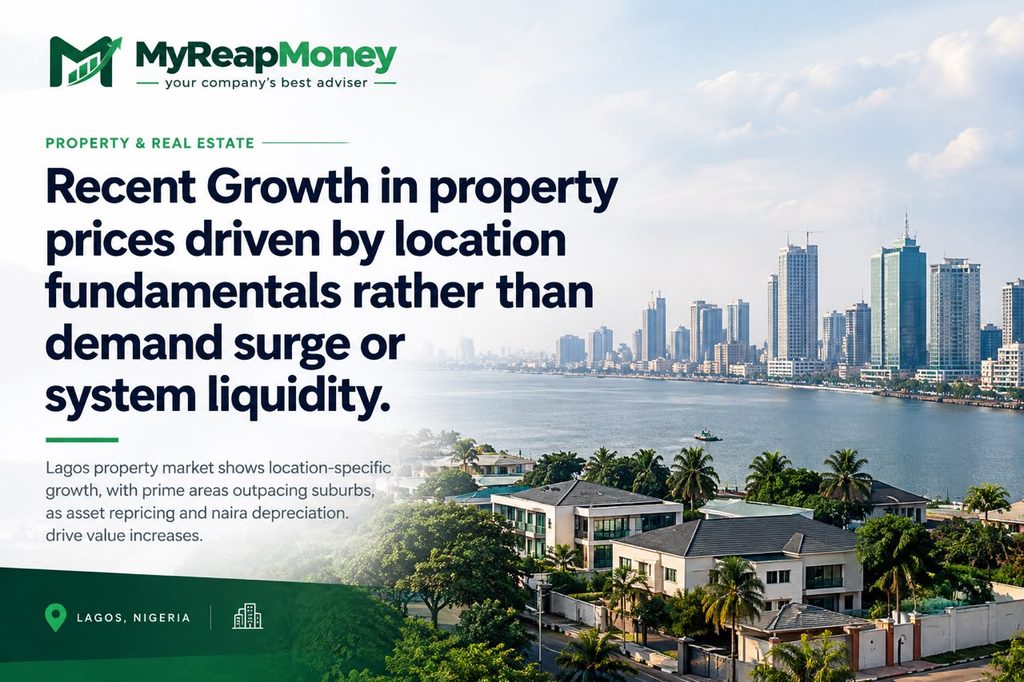
Contrary to widespread opinion, the spike in property prices in Lagos in recent times is not general and is driven by the fundamentals specific to each location.
Investigations conducted by myreapmoney.com shows that prime locations such Ikoyi and Victoria Island in Lagos attracted over 250% growth in value in three years, on the average, while less cosmopolitan areas like Ikorodu and Iyana Ipaja grew by less than 35%.
The investigation also revealed that asset repricing caused by naira depreciation rather demand surge was the major cause of the price spike.

For example, a square meter of land in Eko Atlantic, a high brow seaside location in Lagos, rose by just 15% from $1,500 in 2020 to $1,725 in 2026. Many of the property transactions in Eko Atlantic are conducted in the US dollar.
However, if the transaction is done in naira, the land value would have grown by almost 300% from N630,000 to N2.4 million. However, suburb locations in Lagos have recorded less proportionate growth than their prime location counterparts with a location like Ikorodu interior growing by less than 15% from N500,000 per plot (an average of 600 square meters) to N in 2020 to 2026.
Generally, Lagos prime locations grew in value by an average of 300% within a 6-year period while non-prime locations grew by 25%. The prime locations within our coverage are Eko Atlantic, Banana Island, Old Ikoyi, Victoria Island, Lekki Phase 1, Magodo Phase 2 and Ikeja GRA
The non-prime locations we covered are Alimosho, Ikorodu, Ojoo, Badagry and Epe suburbs.
Jide Shittu, an estate valuer, explained that the disparity in growth reflects the different market characteristics of the different locations pointing out that real estate assets respond to changes in economic variables in different ways. ”
An Ikorodu property is not likely to be priced in dollars like an Eko Atlantic or Victoria Island property. So, the conversion adjustment factor is minimized in a typical suburban transaction. Price growth will only mirror general inflationary trend. Certainly, real estate assets will always appreciate but rates of appreciation will vary between locations”.
The foreign element probably explains why Lagos Island properties generally appreciate faster than their mainland counterparts. The Nigerian diaspora population, in countries like the United States, the United Kingdom and Canada, are more attracted to the freshness and dynamism of Lagos Island properties as many of the new buildings springing up in these locations mirror, to some extent, the environments in their adopted countries.
This open preference by this category of buyers and investors, many of whom do so also for speculative purposes, also introduce foreign exchange elements into the transactions.
Though the naira has been relatively stable in the last two years, the volatility that has been associated with it up to 2024 has largely shown up more on the Lagos Island real estate markets where the diaspora population has been more present. Land bankers have succinctly factored in foreign exchange rates at different times into the pricing mix to capture the exchange rate differentials caused by currency devaluation or depreciation.
