CNG Massive Offtakes Among the Poor Mirrors Widening Inequality in Nigeria.
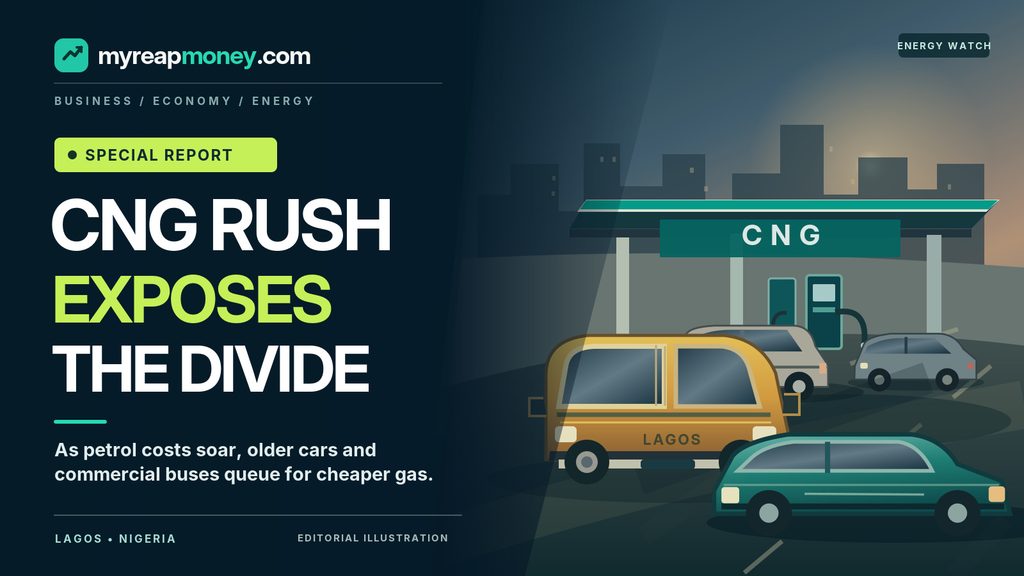
A typical Compressed Natural Gas (CNG) filling station now exposes Nigeria’s widening inequality as the poor and struggling middle class population switch from petrol to gas to escape crushing prices of premium motor spirit.
A recent investigation conducted by myreapmoney across five CNG filling stations in Lagos shows long queue of vehicles waiting to be filled with 95% of them being private of over 15 years and commercial buses and trucks.
The investigations were conducted in CNG filling stations in Ogudu, Ojota, Ikeja, Marina and Lekki. Myreapmoney deliberately selected CNG locations with a fair level access to low-income and middle-class segments of the population to control for geographical income level bias.

In the last three years, the price of petrol has spiked from N169 ($0.12) to around N1,400 (depending on the location) against the background of the decision of the current Tinubu administration to remove subsidies. As part of the measures to cushion the effect of the fuel subsidy removal, the government has been promoting CNG adoption as a cheaper alternative. CNG presently sells for an average of N380 per standard cubic metre (SCM).
An SCM of CNG will generate about 1.15 of petrol, implying that a N50,000 spend will produce about 35 litres of petrol and about 130 litres of petrol, a difference of more than 350%.
However, the adoption of CNG has received different levels of adoption across the different income classes. The poor and the lower part of the middle class have largely embraced it while the upper middle class and the rich have stuck to petrol mirroring the effects of “indirect tax” on the populace and the ability of the various categories of people to respond to it.
An economist, Bowale Komolafe said “its income elasticity effect. The higher the level, the lower the level of price elasticity. This means if your income is high, you will have a greater ability to absorb higher prices”.
Income elasticity is a concept in economics that describes how changes in income respond to demand. The higher an income is, the higher the demand of a typical item is expected to be.
Petrol price being an essential component of the energy ecosystem has been a political hot button in recent times. Energy cost accounts for an average of 20% of the monthly expense of over 10% of the people living in Nigeria, which per capita income is less than $1,500.
This has shown in the severe impact the subsidy removal has taken on many people, with many of them in the low-income category transitioning into CNG as they seek alternatives to the rising energy costs.
Our investigations showed many of the vehicles in these locations being old and dilapidated versions of cars like Toyota Corolla, Honda Accord, Nissan Sierra and Toyota Camry, with many being manufactured as far back as 1998.
Monday Erunse, one of the drivers who spoke to myreapmoney, said “I operate a commercial bus. How can I charge a good price and still make profit from a fuel price of N1,600. How many people can afford the transport fare?”.
However, the long queues in many of these stations suggest that the demand of CNG is now outstripping supply to underscore the “substitution effects” of the price increase.