

UAC, Ellah Lakes Offer Contrasting Lessons on the Success of Private Equity
Private equity czars are generally regarded as the king of finance. They raise funds, buy into companies, particularly those that are struggling but have potential, do some re-engineering like downsizing or asset stripping, return the companies to the path of efficiency and profitability and exit if need be.
The private equity market in Nigeria is relatively small as a means of business finance compared to other traditional sources like bank loans and even public issues. Private equity in the market between 2020 and 2024 was about $3 billion while commercial banks’ loans extended within that period was over $27 billion, according to the information obtained from CBN documents.
The success or failure of a private equity investment is hard to measure because some of the target companies are private. However, the experiences of two public companies, UAC Nigeria and Ellah Lake provide contexts for understanding the factors that may drive success or failure.

Since 2018/2019 when the private equity investors acquired equity stakes in both companies, the outcomes have been different reflecting the importance of the underlying fundamentals of the companies being bought into and the strategic expertise of the respective investors.
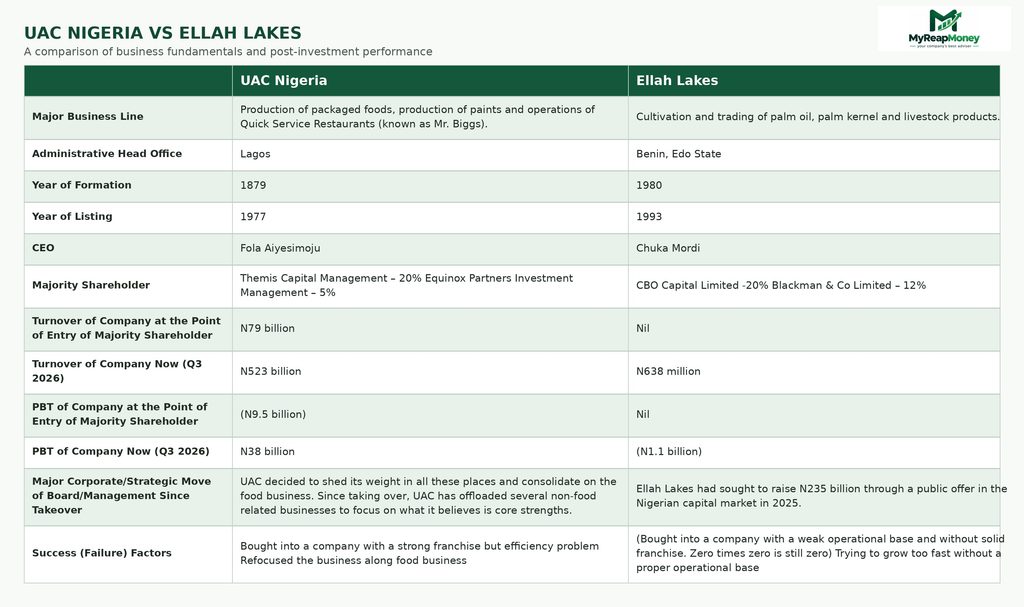
Themis Capital, led by Fola Aiyesimoju, has made an outstanding success of the company’s investment in UAC blowing its (UAC’s) revenue by over 560% in less than 10 years and with records of divestments and acquisitions that indicate the company’s strategic pivot and its underlying perspective on the future of FMCG business as a whole in Nigeria. On the other hand, the change in ownership and management has failed to lift Ellah Lakes out of its shadows, with revenue still being less than N1 billion, seven years after.
While UAC has expanded through a chain of strategic divestments and acquisitions, Ellah Lakes has remained stuck to its roots with a chain of missteps, the biggest being an ill-fated attempt to raise N235 through a public offer in the Nigerian capital market in 2025 “to expand its production capacity, diversify revenue streams, and support its transition from a restructuring phase to a full-scale growth and expansion cycle.”
The offer which was significantly undersubscribed had left the agro business severely undercapitalized, unable to take advantage of the huge opportunities in the country’s agriculture space.
On the other hand, UAC has been offloading its non-food related businesses to focus on what it believes is core strengths. The company sold 73% of its stake in Livestock Feed to Sunbeth Treenuts and Sesame Limited in a deal valued at N19.5 billion ($15 million). In 2020, it sold its majority stake, of about 51% shareholding in UAC Property Development Company (UPDC) to Custodian Investment Plc. In 2025, it acquired ChiHollandia from the Coca Cola Company in a deal valued at over N182 billion, the largest of such transactions in the Nigerian capital market.
The series of divestments and acquisitions is reflective of the changing strategy of the conglomerate, a clear signal of redirection from opportunistic businesses to what the new management probably consider its core: packaged foods. Why is UAC’s meat seeming like a poison for Ellah Lakes? Three factors stand out: the underlying assets of the company being acquired, the post acquisition strategies and the types of capital being deployed to fund those strategies.
First, the underlying assets. When an activist (name withheld for discretionary reasons) said Nigeria started as a business before becoming a political entity, he was referring to UAC. The company which came into existence before the historic amalgamation of 1914, was Nigeria’s first and longest surviving formal business. As at the time of Themis Capital’s entry into the company, its (balance sheet) was over N130 billion spread beyond the shores of Nigeria. On the hand, Ellah Lakes was a struggling business with only a couple of fishponds and a listing on the then Nigerian Stock Exchange. The new equity investors must have been banking on the listing status for a direct access to the public market for capital but listing alone does not sway investors.
UAC had revenue (of almost N80 billion) as at the time the new core investor took over and was only struggling with management challenges and operational inefficiencies. Ellah Lakes had no operations at all as even the few fishponds it owned had been overran by the marauding militants in the Niger Delta.
Secondly, UAC streamlined its post-acquisition strategies to focus on packaged foods, shedding weight in non-core food businesses such as property and animal feeds. At the same time, the company consolidated its hold in the packaged food business with the ultimate move being the acquisition of Chi. UAC focused on businesses that had short time to market and were already generating cash, with established brand names and distribution networks. On the other hand, Ellah Lakes, with no assets to generate quick cash, concentrated on acquiring assets with long-term gestations such as oil palm plantations. Even though oil palm businesses are cash-cows at maturity, investors cannot entrust N235 billion with management that has not proven their mettle in that space. Even Aliko Dangote would not have floated its refinery at the point of ideation.
And the third factor which is more less tied to the second, is the type of capital being deployed post-acquisition. UAC has largely stuck to debt since most of the assets are already generating cash and can prove themselves. Although no debt, of whatever nature, would have been suitable for a 30,000 hectares oil palm plantation, Ellah Lakes’ decision to go that far at the first seems overtly ambitious.
The company is not Presco or Okomu and must have been daring to expect investors to use the same crystal ball to forecast their performance.
When private equity investors announce their appearance in companies, they are always expected to carry the magic wand. Afterall, they are around because the present and owners and managers have not demonstrated sufficient understanding of the subject matter. While Fola Aiyemosiju may have proven this maxim right, it is difficult if Chuka Mordi can say the same. As the mantra goes, two balls may look the same but one is thicker than the other.
