
Access Holdings Allocates 20.57 Million Shares to 56 Employees Under Share Vesting Arrangement

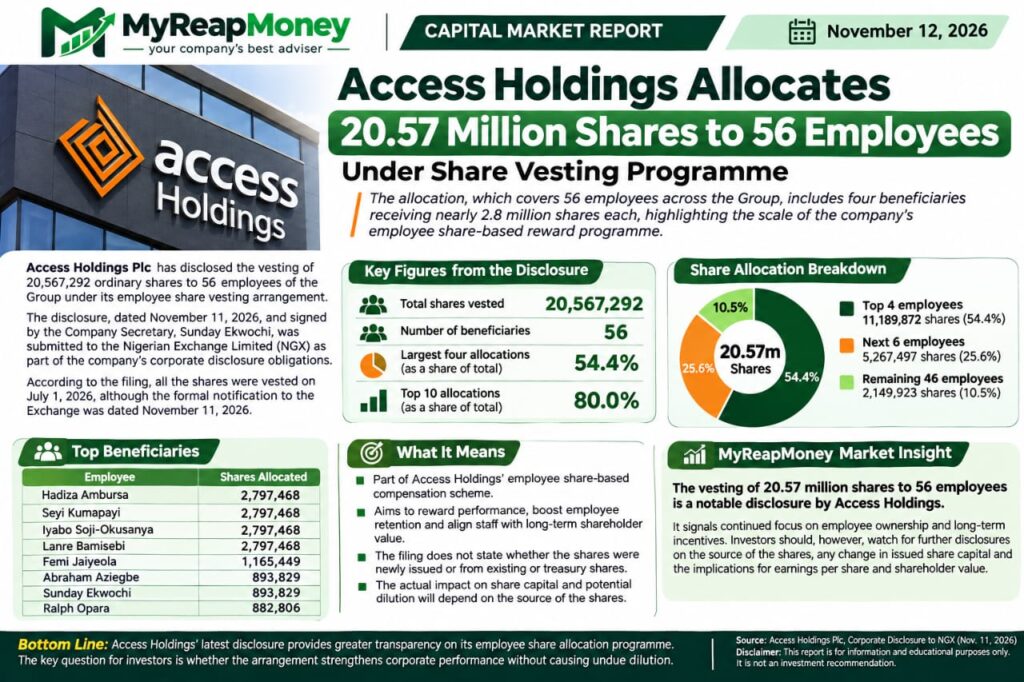
The allocation, which covers 56 employees across the Group, includes four beneficiaries receiving nearly 2.8 million shares each, highlighting the scale of the company’s employee share-based reward programme.
Access Holdings Plc has disclosed the vesting of 20,567,292 ordinary shares to 56 employees of the Group under its employee share vesting arrangement.
The disclosure, dated November 11, 2026, and signed by the Company’s Secretary, Sunday Ekwochi, was submitted to Nigerian Exchange Limited (NGX) as part of the company’s corporate disclosure obligations.

According to the filing, all the shares were vested on July 1, 2026, although the formal notification to the Exchange was dated November 11, 2026.
The disclosure provides details of the employees and the respective number of shares allocated to each beneficiary.
Four Employees Receive Nearly 11.2 Million Shares
A review of the filing shows that four employees received the largest individual allocations of 2,797,468 shares each.
The beneficiaries are Hadiza Ambursa, Seyi Kumapayi, Iyabo Soji-Okusanya and Lanre Bamisebi.
Collectively, the four employees received 11,189,872 shares, representing approximately 54.4% of the total shares listed in the disclosure.
Other significant allocations include:
- Femi Jaiyeola: 1,165,449 shares.
- Abraham Aziegbe: 893,829 shares.
- Sunday Ekwochi: 893,829 shares.
- Ralph Opara: 882,806 shares.
- Gavin Greenway: 688,608 shares.
- Lookman Martins: 633,378 shares.
- Abiodun Dada: 629,716 shares.
The remaining beneficiaries received varying allocations, with several employees receiving between 4,276 and 27,185 shares.
What the Disclosure Means for Access Holdings
Employee share vesting is a compensation mechanism through which eligible employees receive shares after meeting the applicable vesting conditions.
For companies operating in competitive industries such as banking and financial services, share-based incentives can serve as a tool for employee retention, performance alignment and long-term commitment to corporate objectives.
By linking part of employee compensation to ownership in the company, management can encourage beneficiaries to pay closer attention to the organization’s long-term performance and shareholder value.
However, the filing does not provide details of the specific performance conditions, vesting terms or the broader employee share incentive programme under which the allocations were made.
Potential Implications for Shareholders
From an investor’s perspective, the disclosure raises an important consideration: the impact of employee share-based compensation on the company’s shareholding structure and potential shareholder dilution.
The actual effect depends on the source of the vested shares.
If the shares were newly issued, the transaction could increase the company’s outstanding share capital and dilute existing shareholders’ percentage ownership.
However, if the shares came from existing or treasury shares, the implications would be different.
Access Holdings did not specify the source of the shares in the disclosure. Therefore, it would be premature to conclude that the vesting resulted in an increase in the company’s issued share capital.
Investors should also distinguish between the number of shares vested and the actual market value of the allocation. The filing does not state the market price or monetary value of the shares at the vesting date.
MyReapMoney’s Financial Perspective
The vesting of 20.57 million shares to 56 employees represents a notable employee share-based compensation disclosure by Access Holdings.
The concentration of more than half of the disclosed allocation among four beneficiaries is also an important feature of the transaction.
For shareholders, however, the bigger issue is not simply the number of shares vested but how the arrangement affects the company’s capital structure, earnings per share and long-term shareholder value.
Investors should monitor subsequent corporate disclosures for information on the source of the shares, any changes in issued share capital and the company’s broader employee incentive arrangements.
The transaction should not, on its own, be interpreted as either a positive or negative signal for Access Holdings’ share price.
A proper investment assessment would require additional information, including the company’s financial performance, earnings outlook, capital adequacy, dividend policy and prevailing market valuation.
Bottom Line: Access Holdings’ latest corporate disclosure provides shareholders with greater visibility into its employee share allocation programme. The key question for investors is whether the arrangement strengthens employee commitment and corporate performance without creating unnecessary dilution for existing shareholders.
Source: Access Holdings Plc, Vesting of Access Holdings Plc’s Shares, corporate disclosure to Nigerian Exchange Limited dated November 11, 2026.
Disclaimer: This report is for financial information and educational purposes. It is not an investment recommendation or an instruction to buy or sell Access Holdings shares.