

Nigeria’s Market Capitalization Hits 35% of GDP, Improves Outlook for Long Term Financing
The equity market capitalization of the Nigerian Exchange Limited is now 35% of the nation’s Gross Domestic Product (GDP), signalling a significant improved outlook for long-term funding for investment activities in the country.
Market Capitalization to GDP Ratio, otherwise known as the Buffer Indicator, is used by market analysts, stockbrokers and investment bankers to assess the level of overvaluation or otherwise of the stocks in a given economy.
The model was developed by Warren Buffet, the renowned investor and boss of Berkshire Hathaway, who describes it as “probably the best single measure of where valuations stand at any given moment”.

The equity market capitalization of the Nigerian Exchange Limited is a measure of the value of all the ordinary shares listed on the Exchange at a point in time.
Market capitalization as a percentage of Nigeria’s GDP rose from 13% in 2021 to around 35% in October 2026 to indicate growing investors confidence in Nigerian stock economy and the increasing use of its capital market to fund long-term investments. Nigeria’s GDP in 2021 was N173.5 trillion, rebased to 2019 base year while market capitalization was N22.3 trillion.
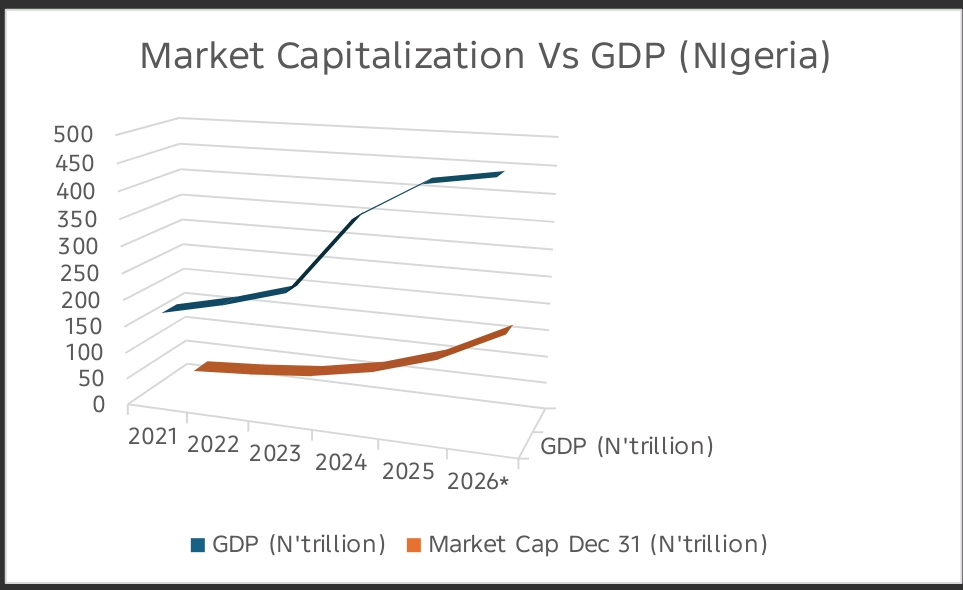
GDP was N27.9 trillion in 2022, N40.9 trillion in 2023 and N62.8 trillion in 2025 while Market Capitalization was N199.3 trillion, N234.4 trillion and N372.8 trillion respectively. As at October 20, 2026, Market Capitalization was already N157.7 trillion while GDP is projected at N461.3 trillion.
Capital market activities have largely been buoyed in recent times by Nigerian banks who raised over N4.6 trillion (about $3.45 billion) from the market under a CBN mandated recapitalization drive.
The Nigerian financial market had over the years been dominated by commercial banks who provide most of its business funding. This situation has resulted in a low level of capital formation as investors and businesses find it difficult to source patient capital for long-term projects.
The economic landscape has largely been dominated by informal and semi-structured businesses most of whom engage in primary agriculture, trading and general commerce with importation substantially dominating economic activities while almost nothing of value apart from crude oil is exported.
The recent renaissance in the stock market is however providing a anchor for large companies to raise funds from the capital market as evidenced by the ongoing initial public offer by Dangote Refineries. Aliko Dangote, the promoter, also recently his desire to list its fertilizer company on the Nigerian Exchange Limited soon.
In rich and developed emerging markets, the capital market provides cheaper and more sustainable funding platforms for long-term projects. In the United States, market capitalization to GDP ratio is 235%, underscoring the high level of impact of the capital market in the investment climate of the country. In China, the UK and the European Union (EU), the ratios are 80%, 122% and 65% respectively.
