

Nigeria’s Energy Sector at a Turning Point as CBN, NNPC Sign Deal Amid Global Oil Market Uncertainty
ABUJA, Nigeria | Wednesday, 19 November 2026
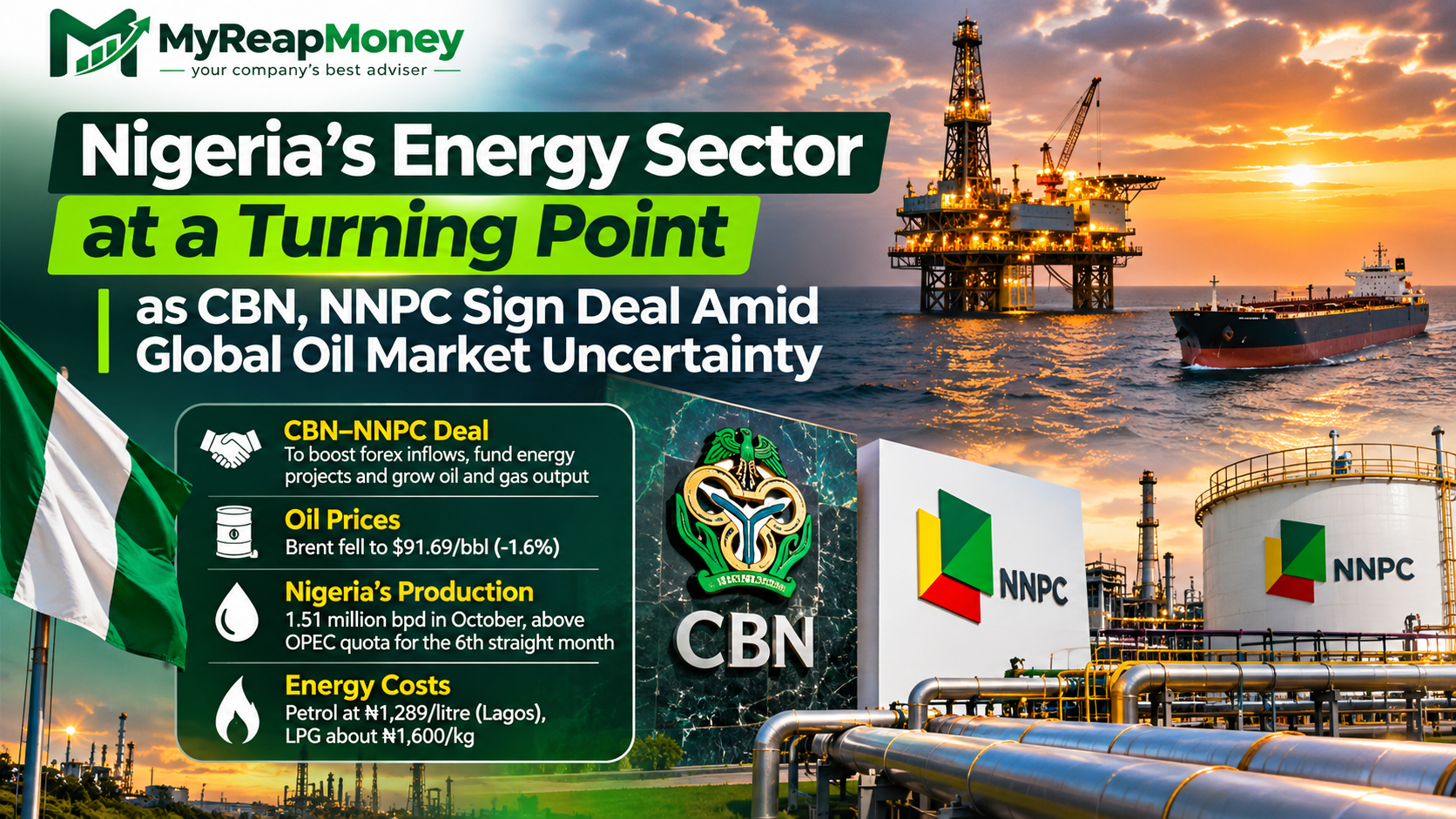
Nigeria’s energy sector is facing a critical period of opportunity and uncertainty following a new agreement between the Central Bank of Nigeria (CBN) and the Nigerian National Petroleum Company Limited (NNPC), aimed at strengthening foreign-exchange inflows, financing energy projects and accelerating the development of the country’s oil and gas assets.
The agreement, announced on Wednesday, comes as Nigeria seeks to improve oil production, attract investment into its energy industry and strengthen the contribution of petroleum exports to foreign-exchange earnings.

According to Reuters, the agreement is intended to improve coordination between monetary authorities and the national oil company. However, specific financing arrangements, project details and implementation timelines have not yet been disclosed.
Global oil prices decline amid rising US inventories
International crude oil prices came under pressure on Wednesday following a larger-than-expected increase in American crude and fuel inventories.
Brent crude declined approximately 1.2% to $92.02 per barrel, while US West Texas Intermediate (WTI) fell 1.9% to $84.38 per barrel in the reported trading session.
Data from the US Energy Information Administration showed that:
- Crude oil inventories increased by 3.4 million barrels.
- Gasoline inventories rose by 5.2 million barrels.
- Distillate inventories increased by 1.6 million barrels.
The inventory increases reinforced concerns about global oil supply exceeding demand, putting pressure on international crude prices.
However, escalating tensions involving the United States and Iran, alongside attacks on shipping around the Strait of Hormuz, continue to create uncertainty in the global energy market.
The Strait of Hormuz is one of the world’s most important oil transportation routes. Prolonged disruption could increase international shipping costs, insurance premiums and crude oil price volatility.
Nigeria maintains oil production above OPEC quota
Nigeria recorded another important milestone in its upstream petroleum sector in October, maintaining crude production above its Organisation of Petroleum Exporting Countries (OPEC) allocation for the sixth consecutive month.
Data released by the Nigerian Upstream Petroleum Regulatory Commission (NUPRC) showed that:
| Production indicator | October 2026 |
|---|---|
| Crude oil production | 1.51 million barrels/day |
| Crude and condensate combined | 1.688 million barrels/day |
| OPEC crude production quota | 1.50 million barrels/day |
| Highest daily production | 1.79 million barrels/day |
| Month-on-month crude production change | -1.7% |
Although production declined by 1.7% compared with September, Nigeria remained slightly above its OPEC crude production allocation.
The regulator attributed the sustained performance to improved operational stability, production uptime and more efficient crude evacuation.
For Nigeria, maintaining production above its OPEC quota is important for government revenue, foreign-exchange earnings and investor confidence.
However, lower international oil prices could reduce the financial benefits of increased production.
Gas production and electricity supply remain major challenges
Nigeria is also intensifying efforts to expand natural gas production and utilisation.
NNPC recently disclosed that national gas production stands at approximately 7.5 billion standard cubic feet daily, with targets of 10 billion cubic feet by 2027 and 12 billion cubic feet by 2030.
The company also reported approximately 10% growth in gas production volumes in 2026 year-to-date.
Despite these developments, electricity generation continues to face challenges.
NNPC maintains that its gas transportation network remains available to support deliveries to power stations. However, the Nigerian Independent System Operator has previously identified limited gas availability and reduced water inflows to hydroelectric facilities as contributing factors to lower electricity generation.
The disagreement highlights the need for better coordination among gas producers, transporters, electricity generators and grid operators.
Nigeria’s electricity challenges also include ageing infrastructure, transmission limitations, vandalism, inadequate metering and financial difficulties across the electricity value chain.
Petrol prices and household energy costs
Domestic fuel prices remain an important issue for Nigerian households and businesses.
Dangote Refinery reportedly reduced its petrol gantry price by ₦51 to ₦1,159 per litre.
However, NNPC retail outlets were still reporting petrol prices of approximately ₦1,289 per litre in Lagos and ₦1,325 in Abuja.
The difference between refinery gantry prices and retail pump prices reflects additional distribution and marketing costs.
Meanwhile, cooking gas prices remain under pressure. Industry reports indicate that the average retail price of LPG reached approximately ₦1,600 per kilogram in November, representing an increase of about 14%.
Higher cooking gas prices are particularly significant for households that have shifted away from kerosene and other traditional cooking fuels.
What the developments mean for Nigeria’s economy
The agreement between the CBN and NNPC could support investment in oil and gas infrastructure and improve coordination around foreign-exchange earnings.
If effectively implemented, the arrangement could help address financing challenges affecting energy projects, improve production capacity and strengthen the contribution of the petroleum industry to Nigeria’s external reserves.
Nevertheless, the outcome will depend on transparent implementation, commercially viable projects, improved production efficiency and sustained investor confidence.
For businesses, developments in crude prices, petrol, diesel and natural gas will remain important determinants of operating expenses.
For households, the key concern is whether lower refinery prices and improved domestic energy supply will eventually translate into more affordable petrol, electricity and cooking gas.
For investors, opportunities may emerge across upstream oil production, gas processing, pipelines, power generation, renewable energy and energy infrastructure.
Outlook: Nigeria must turn energy resources into economic value
Nigeria’s energy sector is entering a period in which production growth, domestic refining, natural gas development and global market developments will increasingly determine economic performance.
The CBN-NNPC agreement is a potentially important step towards stronger institutional cooperation, but its success should be measured by actual investment, improved production, increased foreign-exchange earnings and more reliable energy supply.
The country’s long-term objective must go beyond producing crude oil. It must develop a competitive energy industry capable of supporting manufacturing, attracting investment, creating employment and reducing the cost of doing business.
The central question for Nigeria is no longer simply how much oil and gas the country possesses, but how effectively those resources can be converted into reliable energy, stronger public revenue and sustainable economic growth.
Sources: Central Bank of Nigeria, Nigerian National Petroleum Company Limited, Nigerian Upstream Petroleum Regulatory Commission, US Energy Information Administration, Reuters and Naira Energies. Information current as at 18 November 2026.
